

Learn why foundation moves and how to repair the foundation correctly?

Why does a foundation move?
Most foundations can be classified into one of three types: shallow pier‑and‑beam systems, slab‑on‑ground foundations, and deep pier‑supported structures. Each category behaves in a distinct way, and foundations within the same class typically respond to soil and load conditions similarly. To fully grasp the concepts that follow, review the sections sequentially.
Pier‑and‑Beam Foundations
Shallow pier‑and‑beam (P&B) foundations distribute structural loads across roughly two to three dozen piers. Each pier transfers its load through a relatively small bearing area, resulting in highly stressed support soils beneath the pier bases.
When pier bottoms are shallow—particularly when they terminate at or near grade—the bearing soils tend to migrate laterally over time, producing gradual settlement. If those soils become saturated and lose shear strength, displacement occurs more rapidly, accelerating settlement. Only when the soils are effectively confined and prevented from moving will the piers remain stable, aside from normal subsurface compression.
The mechanism of soil movement can be compared to a pressurized air vessel: compressed air seeks any available path to escape into a lower‑pressure environment unless contained by a rigid boundary. In soils, no such rigid boundary exists; stability depends solely on the soil’s resistance to movement.
Resisting Support‑Soil Movement
- Increase Embedment Depth
Deeper piers reduce the stress gradient between loaded and unloaded soils, lowering the driving force for lateral soil migration. - Increase Bearing Area / Reduce Stress
Additional piers or larger pier bases decrease bearing pressure. A wider base also increases the travel distance required for soil to escape, improving confinement. - Utilize More Stable Soil Profiles
Soil behavior varies significantly. Saturated clays exhibit low shear resistance and move readily, while sandy clays with moderate moisture content are far more stable. - Prevent Non‑Load‑Induced Soil Movement
Any soil movement not caused by structural loading can undermine support.
This concept is critical to understanding why older slab‑on‑ground foundations often settle at the edges. Consider a concrete block resting on sand: disturbing the sand beneath it causes settlement as the sand relocates to zones of lower stress. This is classic undermining.
Under piers, the equivalent mechanism is moisture‑driven shrink‑swell activity in clay soils. Clays vary widely in activity depending on mineralogy and composition. When moisture changes occur, the soil moves independently of the structural load and simultaneously migrates outward to relieve stress, allowing settlement.
Trees often stabilize nearby piers by maintaining consistently dry surface soils, eliminating moisture fluctuations.
Thus, P&B foundation movement typically follows two patterns:
- Long‑term, incremental settlement from slow soil creep beneath the pier base.
- Rapid settlement during flooding when clays lose strength and flow more easily.
Piers do not heave upward; they either remain stable or settle.

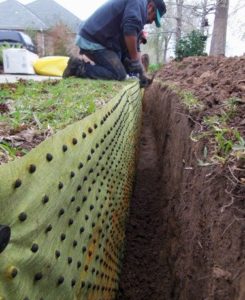
ROOT BARRIER FABRIC

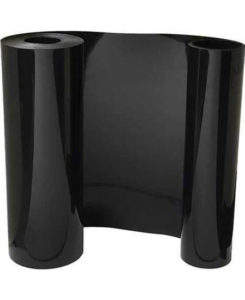
ROOT BARRIER ROLL



Your landscaping specialists in Houston Let our Houston landscaping experts turn your yard into a spectacular showpiece.
 Earth Ideas Outdoors will provide you a Free Estimate for your home.
Contact Us
Monday – Friday 7AM – 5:00PM
Saturday & Sunday Closed
(Phone calls will be answered after hours)